


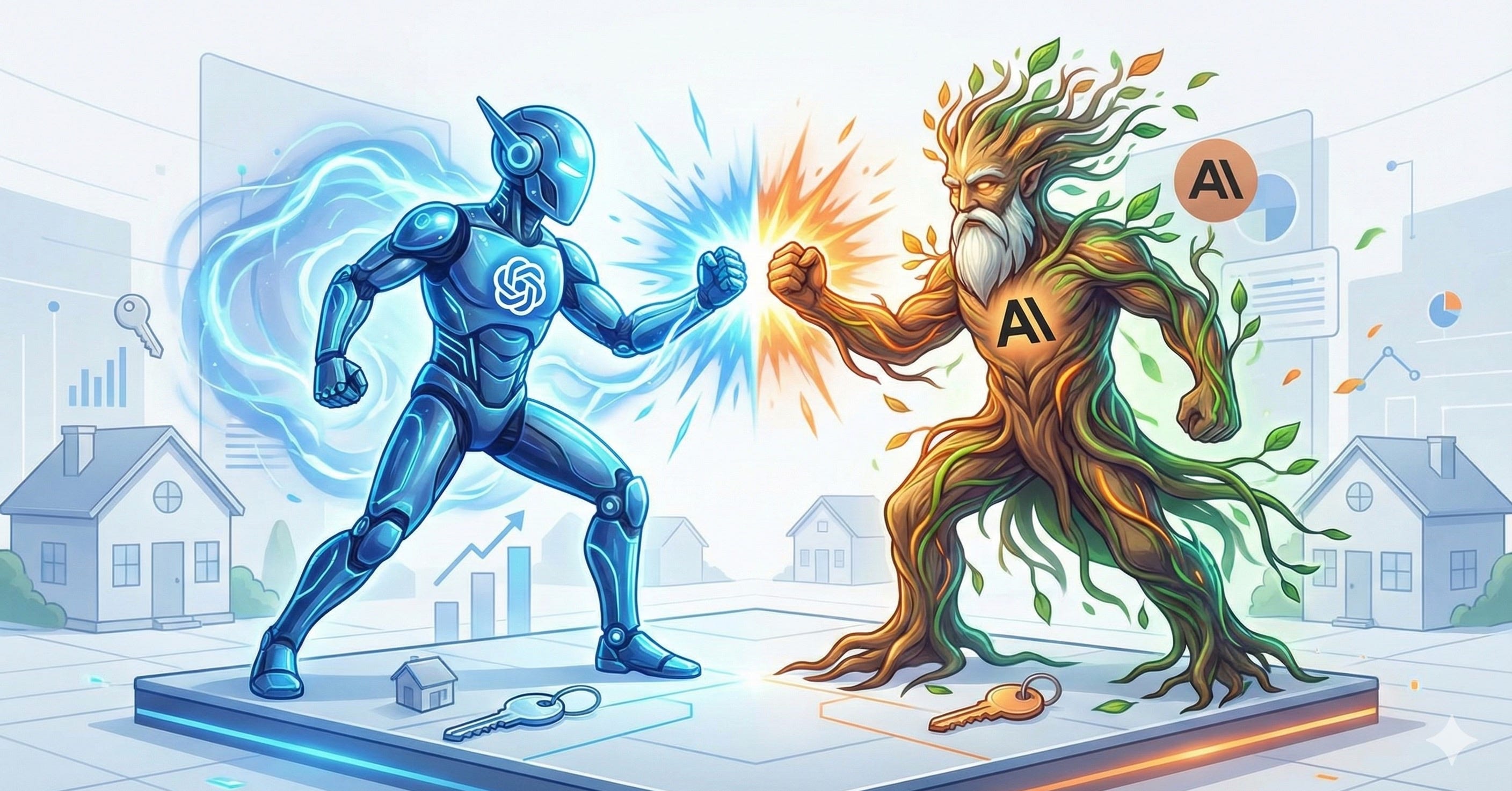
Most people I talk to in real estate default to ChatGPT. It makes sense. OpenAI spent billions on brand awareness. ChatGPT was first to market. It’s literally the Kleenex of the LLM world.
But I’ve been using Claude for years now, and I can tell you with confidence: these are not the same tool. The differences aren’t cosmetic. They’re structural. No matter who you are, understanding those differences matters.
ChatGPT is great at a lot of things. But Claude is where the real work gets done.
Why This Matters Right Now
This week, Anthropic released Claude Opus 4.6, its most advanced model to date. A 1-million-token context window. Agent teams that split complex tasks across multiple AI workers in parallel. The highest scores ever recorded on benchmarks measuring real-world professional work in finance, legal, and other domains.
Days earlier, Anthropic launched a legal plugin for Claude Cowork that automates document review, risk flagging, and compliance tracking. The market’s reaction was swift. Thomson Reuters dropped 16%. LegalZoom fell 20%. The London Stock Exchange Group plunged 13%. Nearly $300 billion in market value was wiped from software stocks in a single day. Traders at Jefferies called it the “SaaSpocalypse.”
The selloff wasn’t about one plugin. It was about what that plugin represented: AI moving from the chatbot layer into the application layer, directly into the workflows where SaaS companies have built their pricing power. The tools are no longer toys. They’re reshaping how professional work gets done.
Credit Where It’s Due
ChatGPT earns its reputation. Real-time web research is fast and fluid. Image and video generation through DALL-E and Sora are strong creative tools. Voice chat with multiple personas is polished.
If your AI use is primarily research, creative brainstorming, and quick technical work, ChatGPT is a solid choice. But that’s not what serious professionals need most.
Start With the Right Foundation
Not every AI tool belongs in every role.
My firm is a Google Workspace client, so we deployed Gemini for Workspace across our entire population. Gemini lives inside the tools our people already use: Gmail, Docs, Sheets, Slides, and Drive. It helps them draft emails, summarize threads, generate listing content, and analyze market data without leaving their workflow.
Most critically, Gemini operates within our secure enterprise environment. Agent communications, client information, and brokerage data stay protected inside our Google ecosystem. For a brokerage with over 1,200+ users across three states handling confidential transactions daily, that security layer isn’t optional.
Gemini for Workspace gives our agents and employees a competitive advantage in their daily production. Claude rivals that for corporate use, and in many ways goes further.
Where Claude Separates Itself
When you need depth, context, and a tool that can hold the weight of real business problems without losing the thread, Claude and more specifically Claude for Teams is in a different class.
Deep document analysis. I regularly upload leases, compliance datasets, vendor proposals, and reports and work through them in ways that would have taken hundreds of hours manually. We’ve run compliance analysis across thousands of agreements, identifying patterns and gaps that would have been buried in spreadsheets for weeks. Both tools offer large context windows now, but Claude maintains coherence and precision across long, complex documents in ways that consistently outperform. A 50-page contract, a dataset with thousands of rows. The quality holds up start to finish.
Writing quality. I’ll say it plainly and many agree: Claude writes better. Not flashier. Better. More structured, more precise, more aligned with the way you actually communicate. Independent reviews consistently describe Claude’s tone as warmer, more contextual, and less robotic. When I’m drafting communications, internal memos, or other messages, Claude produces work that needs less editing.
Projects with real depth. Both platforms offer projects, but the customization is where Claude pulls ahead. You can upload extensive reference documents, build custom instruction sets, and create persistent workspaces that shape behavior at a granular level. We’ve built shared projects for compliance analysis, vendor evaluation, and agent content creation. Each carries its own context and rules. Claude already knows your standards, your voice, and your operating parameters before you type a word.
One of the most powerful applications: agent-specific projects that function as digital twin copywriters. Upload collections of an agent’s prior writing, newsletters, emails, and marketing materials, and you can generate content that matches their voice precisely. Support staff produces on-brand content at speed. For top producers who would rather spend time with clients than writing marketing copy, this is a meaningful unlock.
Memory that actually retrieves. ChatGPT has memory, but in practice it captures high-level preferences and themes. It knows you prefer bullet points or that you work in real estate. What it can’t do is search back through a conversation from three weeks ago and pull the exact analysis you ran. Claude can. I reference a prior vendor comparison, a compliance review, a draft I worked through weeks ago, and Claude searches across past conversations by keyword or time range and returns the actual content. That’s the difference between a tool that remembers your preferences and a tool that remembers your work.
Extended thinking. Claude reasons through complex problems step by step before responding. With Opus 4.6, this evolved into adaptive thinking, where the model dynamically decides how deeply to reason based on the task. I’ve used this for financial modeling, strategic planning, and multi-variable decision analysis. The depth is materially different from a standard response.
Cowork. This changed how I think about what AI can do for a professional. Launched in January, Cowork is fundamentally different from chatting with an AI. You point Claude at a folder on your local computer, describe what you need, and step away. It plans, executes, and delivers finished work: organized files, formatted spreadsheets, polished presentations, synthesized research.
Chat tells you how to do something. Cowork does it. And because it runs locally on your machine with access only to the folders you choose, your data stays where it should.
Cowork is superior to anything I can accomplish in standard chat or with Gemini for Workspace right now. It’s early. It’s a research preview. But the trajectory is clear. This is where professional AI is headed. Not prompting and pasting. Delegating and reviewing. That applies whether you’re organizing files, building a market report, or prepping a presentation.
Claude for Teams
We deployed Claude for Teams across staff in finance, operations, and communications. Shared projects, privacy protections, and collaborative features made the decision straightforward. The tool doesn’t just help individuals work faster. It raises the floor for the entire team.
We also use Claude for Excel for rich data analysis on complex spreadsheets. This isn’t leadership experimenting with a new toy. It’s team members integrating AI into their daily workflows because it makes their work materially better.
The Governance Factor
This matters more than most people realize, especially in a regulated industry like real estate. While both OpenAI and Anthropic now use consumer data to train their models by default, the distinction lies in the Team and Enterprise tiers.
We tested out Claude for Teams because it provides an immediate, legally-backed wall between our proprietary data and the public model. When you’re uploading sensitive agreements or financial modeling, “Opt-out” shouldn’t be a setting you hope your team remembers to toggle, it should be a structural guarantee of the platform. For a brokerage, the choice isn’t just about the AI’s “brain”; it’s about the “vault” it sits in.
Level Up
The professionals who gain real leverage from AI won’t be the ones who adopted it first. They’ll be the ones who adopted it deliberately.
What happened in the markets this week should be a wake-up call. AI is no longer a productivity experiment. It’s becoming the operational layer for professional work. The tools are moving fast, and the people who understand which tool to use, when, and why will have a meaningful advantage over those still defaulting to whatever they heard about first.
I’ve watched Claude evolve from a lesser known alternative into the most capable tool in my daily workflow. If you’re already using ChatGPT and want to go deeper, Claude is the logical next step. Not because ChatGPT is bad. Because once you experience the depth of what Claude offers, you won’t want to go back.
The strategy isn’t picking the AI everyone knows. It’s picking the right tool for the job you actually need done.